Small Apartment Storage Solutions That Don't Look Like Storage
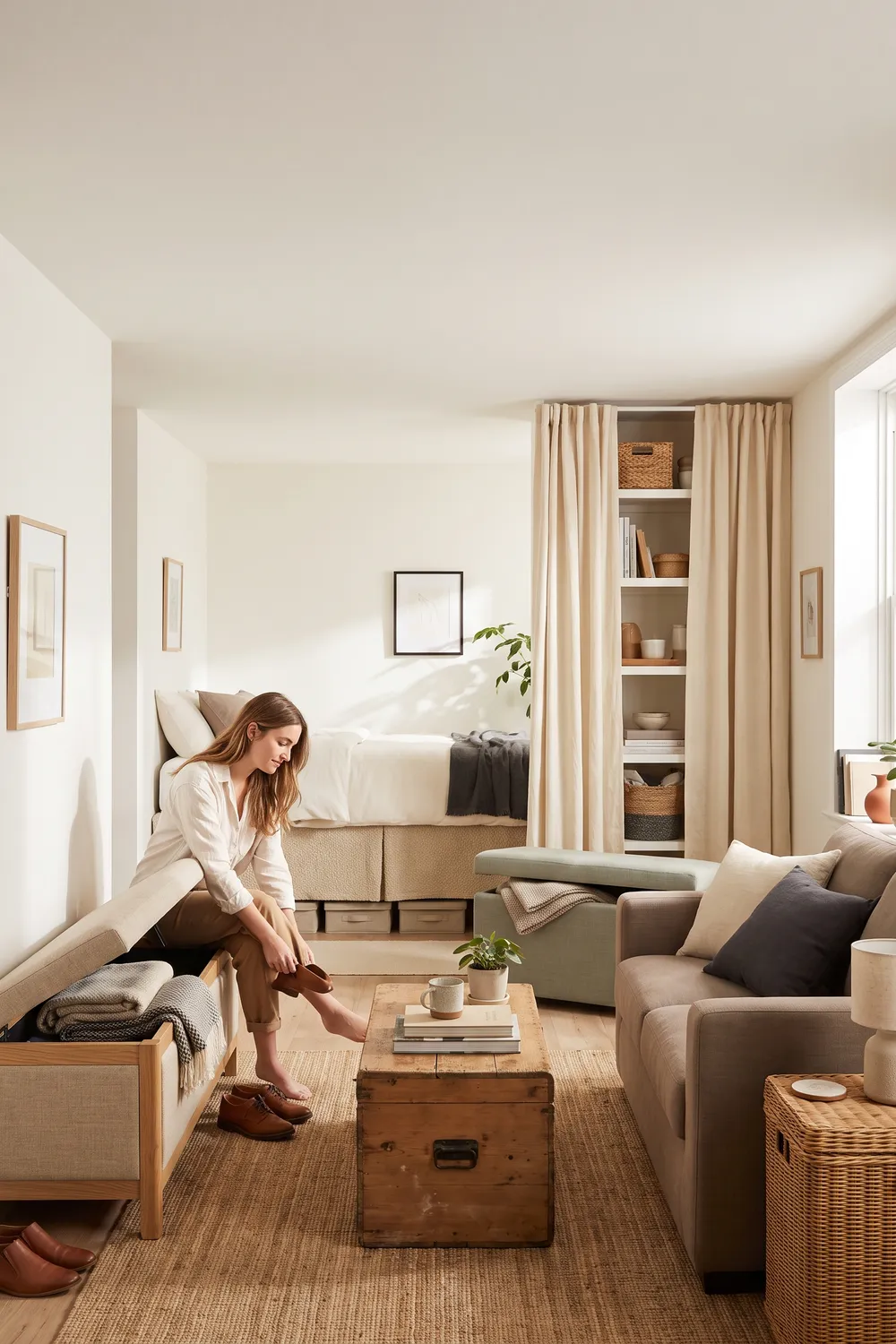
Obvious storage, stacked bins, a wall of visible shelving, works fine in a garage. In a small apartment where the living room is also the office and the bedroom is also the closet, storage that looks like storage just adds visual clutter on top of the actual clutter it’s supposed to solve. These six do the same job while reading as furniture first.
1. A storage ottoman
From across the room it’s a footrest or a coffee table. Lift the top and it holds blankets, extra pillows, or anything else that doesn’t need daily access. It’s one of the few pieces of furniture that adds real storage volume without adding floor footprint, since it was already going to be sitting there as seating or a table.
Where it doesn’t help: anything you need multiple times a day. Digging through an ottoman for a remote you use constantly gets old fast. Reserve it for things you grab occasionally, not daily essentials.
2. Under-bed storage with a bed skirt
The space under a bed is often the single largest unused storage volume in a small apartment, and most of it goes to waste because bins under a bed frame are visible from across the room. A simple bed skirt hides that same storage completely, so flat bins holding off-season clothes or extra linens disappear from view without needing a different bed.
Where it doesn’t help: it only works with bed frames that have clearance underneath. A platform bed with a solid base has nowhere for bins to go, so check what’s actually under the mattress before planning around this.
3. A storage bench at the end of the bed or by the door
Functions as a bench for sitting, tying shoes, or setting down a bag, while the seat lifts to reveal storage underneath. In an apartment without a mudroom or entryway closet, this does double duty as both entryway seating and the closet substitute.
Where it doesn’t help: benches with storage tend to be heavier and bulkier than a simple ottoman, so in a genuinely tight space, measure carefully. A bench that’s too deep for the room becomes an obstacle, not a solution.
4. Lidded baskets used as side tables
A basket with a flat, sturdy lid can hold a lamp or a drink the same way a small side table would, while the inside holds magazines, cables, or anything else you’d rather not see. Unlike a piece of furniture, a basket doesn’t need to match anything else in the room, so it’s easy to add one wherever a gap exists.
Where it doesn’t help: it won’t hold much weight compared to actual furniture, so this is for a lamp and a coaster, not anything heavy resting on top long-term.
5. Curtain-fronted open shelving
Open shelving is the cheapest storage option in most apartments, but it means everything on it is visible all the time, which reads as clutter even when it’s technically organized. A curtain rod mounted along the front edge turns the same shelving into a hidden cabinet for the cost of a rod and a length of fabric.
Where it doesn’t help: it needs a small amount of extra depth or ceiling clearance to mount the rod without the curtain rubbing against what’s stored on the shelves. Measure before assuming a curtain will fit flush against an existing unit.
6. A trunk as a coffee table
Similar to the storage ottoman, but with more volume and a flat, sturdy top built for actually setting things on, drinks, books, feet. A trunk holds bulkier items an ottoman can’t, extra bedding, seasonal decor, board games, while still functioning as the main table in a living room.
Where it doesn’t help: trunks are usually heavier and harder to move than an ottoman, so this is a better fit for a spot you don’t plan on rearranging often.
The actual principle
Every one of these works by choosing furniture you needed anyway, a coffee table, a bench, a side table, and picking the version of it that happens to be hollow. None of it requires giving up floor space specifically for storage. That’s the difference between an apartment that has storage and one that just has more stuff sitting out.