How to Organize a Small Kitchen Without Buying More Bins
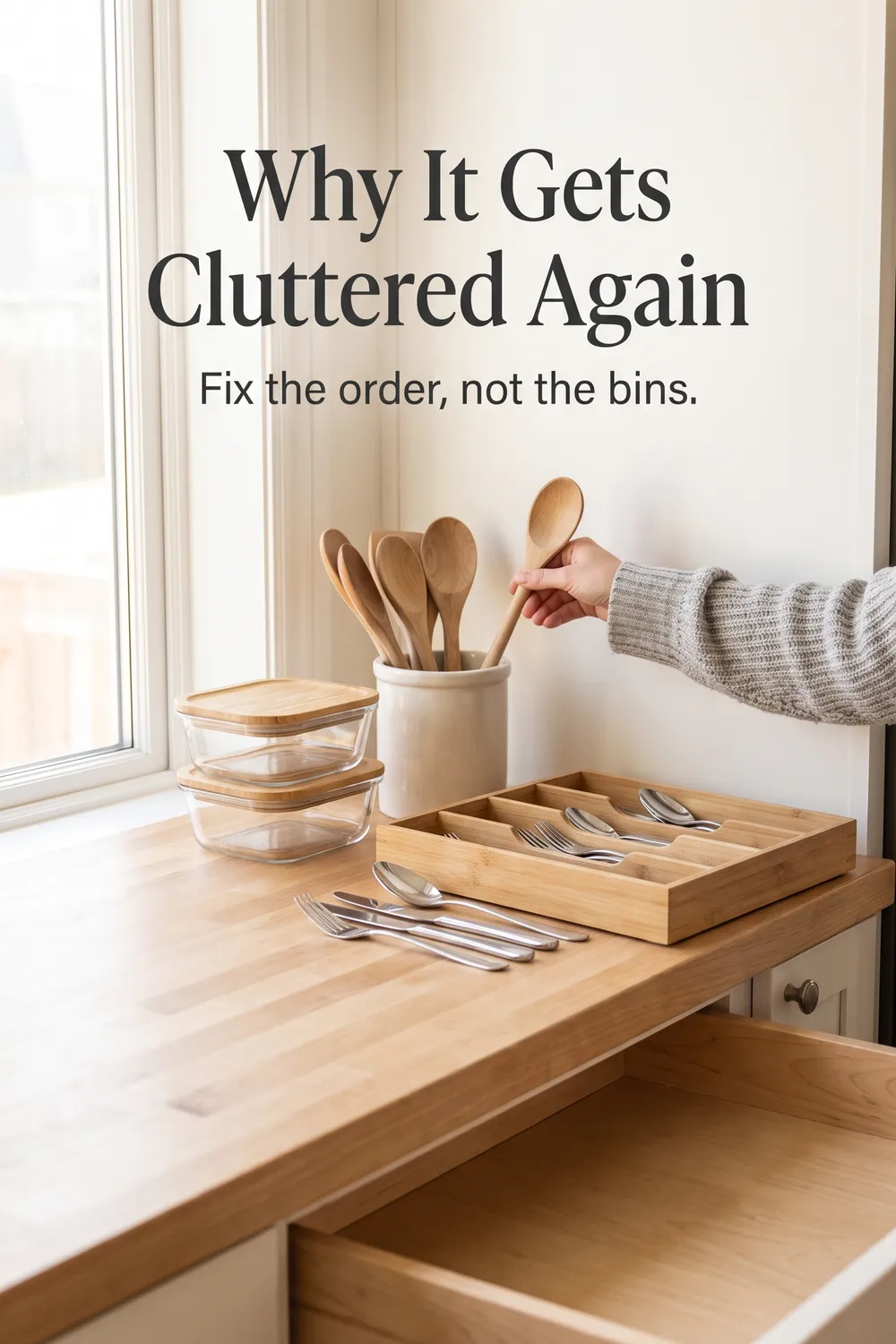
Most kitchen organizing advice starts with a shopping list. You buy the bins, spend a Saturday sorting, and it looks like the photo for about six days. Then the counter fills back up and the conclusion is that you need better bins.
The counter fills back up because everything sitting on it has an inconvenient home. A blender that lives on a low shelf behind the stockpot gets used once and stays out. The mail lands on the island because nothing else has claimed that job. Neither of those is a storage-capacity problem, and neither gets fixed by another container.
Here’s the order that actually holds, which puts buying anything at the end instead of the start.
1. Watch where things land for a week
Before moving anything, notice what accumulates and where. Not a list of what’s messy, a list of what specific objects end up out and which surface they choose. Most kitchens have two or three repeat offenders and a single drop zone that catches everything.
That list is the actual problem statement. If the same three items are out every night, they need a closer home, not a tidier one. If one end of the counter catches mail and school papers, that surface has already been assigned a job by the household, and fighting it is a losing project.
2. Sort by reach, not by category
The instinct is to group like with like: all baking things together, all utensils together. That produces a kitchen that looks organized and works badly, because it puts the flour sifter you use twice a year at the same distance as the spatula you use nightly.
Sort by frequency instead. Things you touch daily go within arm’s reach of where you stand most, usually the stove and the sink. Weekly things go in cabinets at eye and waist height. Anything you reach for a few times a year goes on the top shelf, in the garage, or out of the kitchen entirely. Category groupings can happen inside those tiers, not across them.
This is the step that survives. A daily item stored at daily distance goes back where it belongs without willpower, because putting it away is the path of least resistance.
3. Empty the drawer before you divide it
Dividers make a drawer legible. They don’t make it smaller. A drawer that’s overstuffed before you add trays is an overstuffed drawer with rows in it, and the rows disappear within a month as things get wedged in sideways.
Take everything out first. The realistic filter is not “would I ever use this,” because the answer is almost always yes. It’s “when did I last reach for this, and what did I use instead when I couldn’t find it.” Duplicates fall out of that question fast. So do the four wooden spoons where two would do.
4. Give the drop zone a real home
Every kitchen has one surface that catches keys, mail, and whatever came home in a backpack. Declaring it off limits doesn’t work, because the pile exists for a reason: it’s the first flat surface past the door.
Treat it as a legitimate need instead of a failure. Put something there that’s designed to hold that pile, sized so it can’t grow past its own edges. When the pile has a container, it stops spreading down the counter. Our entryway storage picks cover the same problem one room earlier, which is usually the better place to catch it if your layout allows.
5. Now buy for the gaps that are left
After the first four steps, the remaining problems are specific and small, and that’s the point. You’ll know whether you need a drawer divider or fewer utensils, whether the container situation is a lid problem or a size problem.
That specificity is what makes a purchase work. Our prep station picks cover the drawer and counter side, and the kitchen basics roundup covers storage containers, including why a set of eight identical containers and a set of fifteen mixed sizes solve genuinely different problems. Buying either one before knowing which problem you have is how kitchens end up with three half-used container sets.
The test that tells you it worked
A week after reorganizing, look at the counter. If the same items are back out, the storage you gave them is too far away or too awkward, and no amount of discipline fixes that. Move them closer and try again.
If the counter stays mostly clear and the only thing on it is the drop-zone container doing its job, it held. That’s the whole measure. Not whether the drawers photograph well, but whether putting something away is easier than leaving it out.