How to Decide What to Keep When You're Decluttering
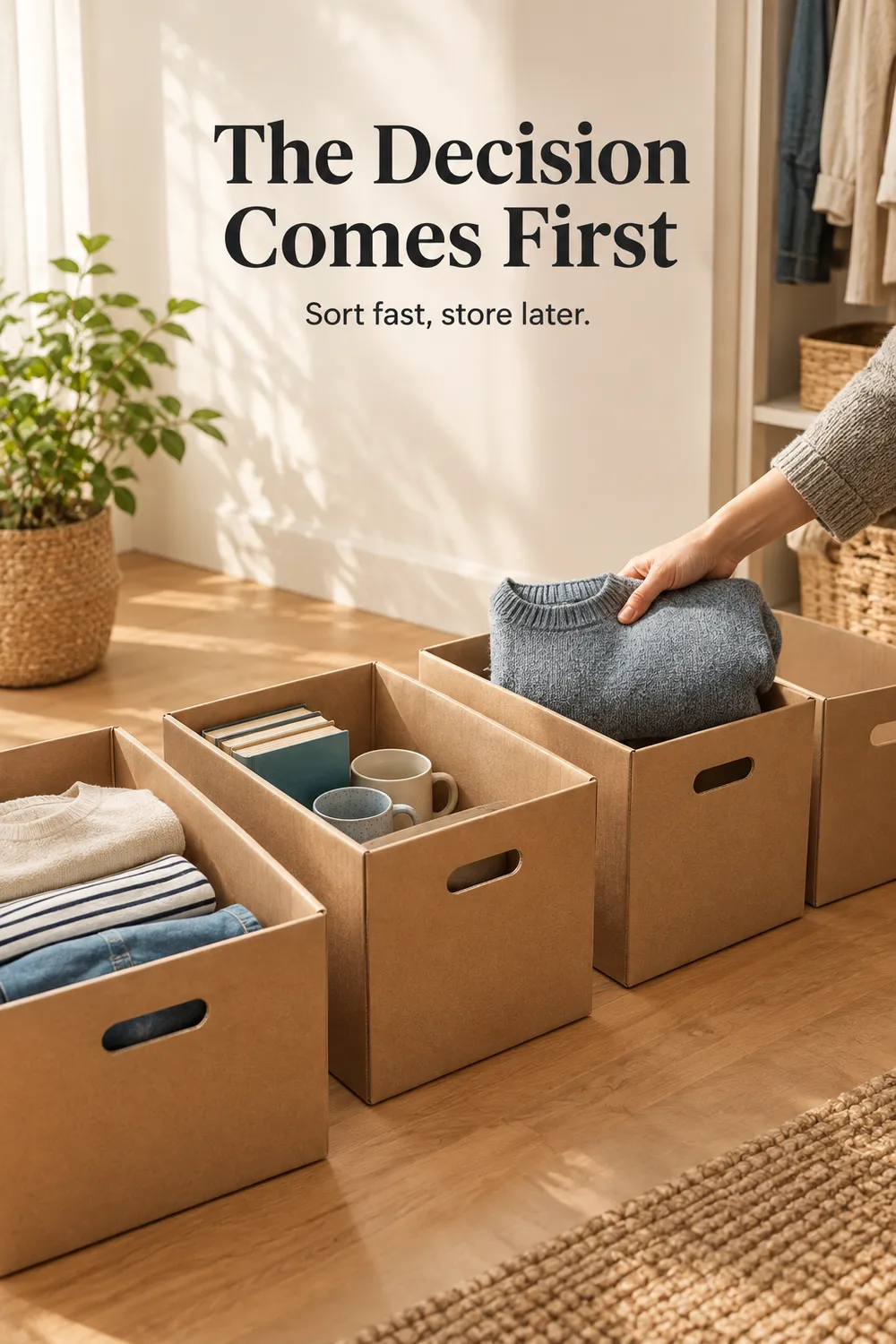
Most decluttering stalls before it starts, not because of a lack of bins, but because every item requires a decision, and deciding is the actual work. A drawer of cables, a closet of clothes that might fit again, a shelf of kids’ art: none of it gets sorted by staring at it longer. It gets sorted by having a faster way to decide than “I’ll think about it,” which is how most of it ends up back on the shelf an hour later.
Our organization roundup and entryway storage ideas cover where things go once you know what’s staying. This is about getting to that point.
Sort into four boxes, not item by item
Deciding “keep or toss” on one object at a time is slow because it’s really two decisions stacked together: does this matter, and where would it go if it stays. Separate them. Label four boxes or piles: keep, donate, trash, and maybe. Pick each item up once, put it in a box, and move on without stopping to plan its future home yet. The placement decision comes later, in a separate pass, once everything is already sorted into those four groups.
This is faster because it removes the second decision from the loop. You’re not asking “where does this go and is it even worth keeping,” you’re asking one question at a time.
Give the maybe box a deadline
The maybe box is doing real work, it lets you move past an item you’re not ready to decide on instead of stalling the whole session over one sweater or one box of cables. The mistake is treating it as a fourth permanent category instead of a temporary holding pen.
Write a date on it, three months out, and put it somewhere out of the way but not out of the house. If the date arrives and you haven’t gone looking for anything in it, that’s the answer: donate or toss the box unopened. Opening it to re-litigate each item defeats the purpose, since you already had that debate once and couldn’t decide. The deadline is what makes the decision for you the second time.
Cap sentimental items to a fixed size, not a feeling
Sentimental items are the ones that break the four-box system, because “does this matter” isn’t really the question with a kid’s old artwork or a relative’s handwriting. The useful constraint isn’t a feeling, it’s a size: one bin, one shelf, one drawer, whatever you pick, and it doesn’t grow. When it’s full, adding something new means taking something else out and deciding it mattered less.
That forces a real comparison between two specific things instead of an abstract judgment about whether any one item is meaningful enough to keep forever. It’s a much easier decision to make.
Count what you actually own before deciding if you need more
Duplicates hide because no single extra mug or extra phone charger feels like the problem. Before deciding whether to keep one, count how many you actually have of that category, then ask how many you’d buy today if you owned none. The gap between those two numbers is usually the answer, and it’s a much clearer test than asking about any single item in isolation.
This works especially well for the categories that quietly multiply: kitchen towels, tote bags, travel-size toiletries, phone chargers. Nobody buys six of something on purpose. It happens one at a time.
Set a one-in-one-out rule for anything that keeps coming back
Toys, kids’ clothes, and anything tied to a hobby don’t get decluttered once and stay decluttered, because more of the same category keeps arriving. For those specific categories, pair the sort with a standing rule: something new in that category means something old leaves it, on the same day, not eventually. Without that rule, the same drawer or bin fills back up within a season and the whole sorting session has to happen again from scratch.
After the decision, the storage question gets simple
Once things are actually sorted into keep and gone, picking where the keep pile lives is a much smaller problem than it looked like at the start, and that’s where a system like the ones in our small apartment storage ideas actually holds up. Storage bought before the decision just gives the undecided pile somewhere new to sit.