Best Entryway Storage Ideas for Busy Households
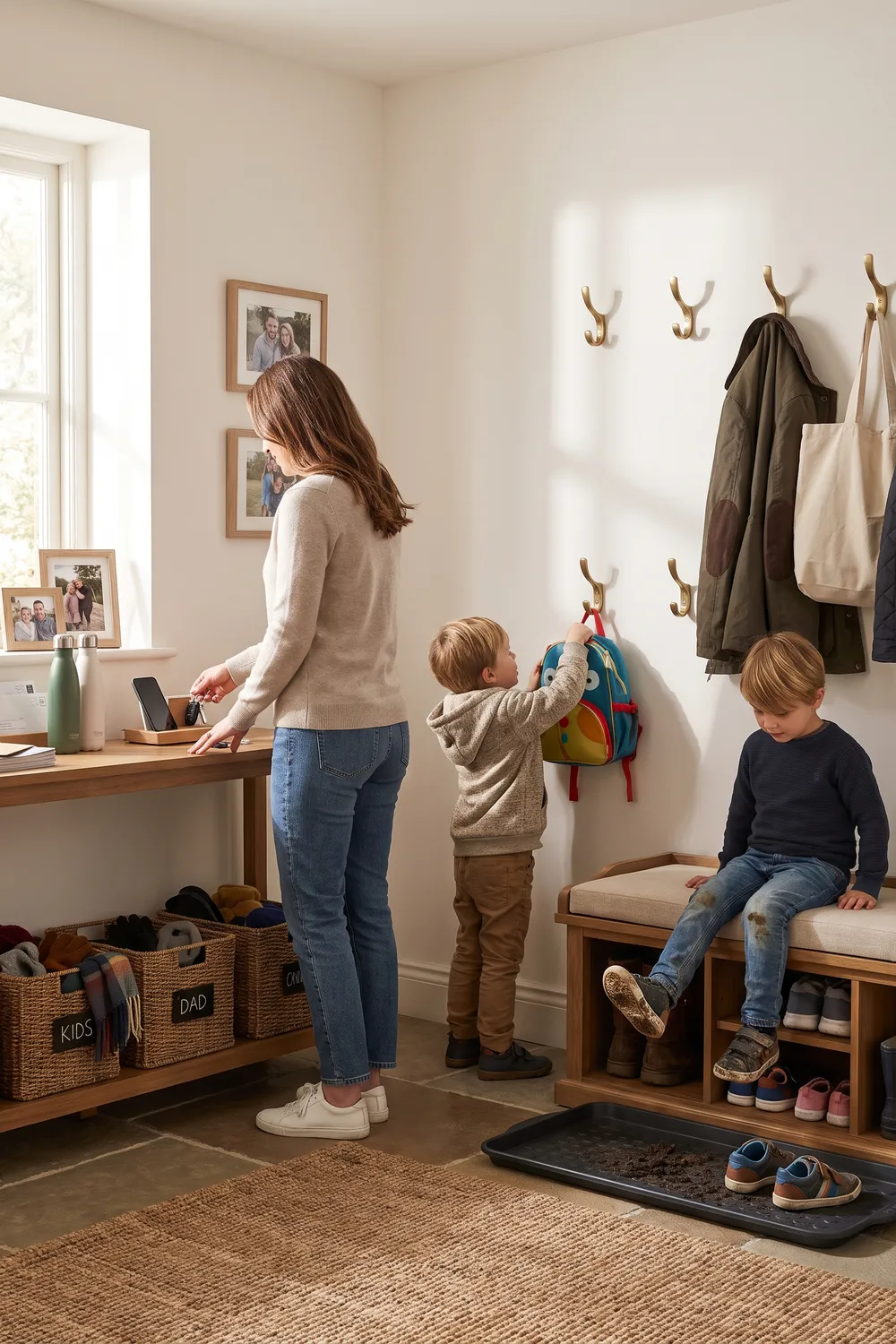
In a house with kids, an entryway is the spot where four sets of shoes, three backpacks, a stack of mail, and whatever someone was carrying when they walked in all land at once, every single day. The ideas below are built around that reality instead of around a Pinterest photo of an empty console table.
1. A bench with shoe storage built underneath
This solves two problems in one footprint: somewhere to sit while pulling shoes on or off, and somewhere for those shoes to actually go instead of scattering across the floor. The sitting part matters more than it sounds, a toddler who has to balance on one foot to get a shoe on takes twice as long and is twice as likely to give up and go barefoot.
Where it doesn’t help: if the entryway is narrow enough that a bench blocks the walking path, this becomes an obstacle instead of a solution. Measure before committing to one.
2. Hooks at two heights, not one
A single row of coat hooks at adult height means anything hung by a kid ends up crooked, half-fallen, or on the floor because they had to jump to reach it. A second row mounted lower, at a height a five or six-year-old can actually reach, means kids can hang up their own bag or coat instead of leaving it wherever they dropped it.
Where it doesn’t help: the lower hooks stop being useful once kids outgrow the height, so this is a solution with a shelf life, not a permanent one. That’s fine, but plan to adjust it in a few years.
3. One labeled bin or basket per person
A shared catch-all bin turns into a pile nobody wants to sort through, because nothing in it is clearly anyone’s responsibility. Individual bins, one per family member, mean a specific person’s stuff has a specific home, and “whose water bottle is this” stops being a daily question.
Where it doesn’t help: it only works if everyone actually uses their own bin instead of dropping things in whichever one is closest. That takes a few weeks of reminders to become habit, it doesn’t happen automatically just because the bins exist.
4. An over-the-door organizer when there’s no closet
Not every entryway has a coat closet to work with. An over-the-door shoe or accessory organizer hangs on the back of whatever door is closest, the coat closet if there is one, a bedroom door if there isn’t, and adds storage without needing to mount anything to a wall or find floor space.
Where it doesn’t help: it holds smaller items well, shoes, gloves, sunscreen, but it’s not built for bulky winter coats or anything heavy. Don’t expect it to replace an actual coat storage solution.
5. A charging spot built into the drop zone
Phones and tablets that get set down “for a second” by the door end up staying there, dead, until someone needs them. A small charging station in the same spot as the keys and bag hooks means the phone gets plugged in as part of walking in the door, not as a separate task someone has to remember later.
Where it doesn’t help: it needs an outlet nearby, so this is easier to add during a move-in or renovation than to retrofit into a spot with no power access. A power strip run along a baseboard can work, but it’s a compromise, not the clean solution.
6. A boot tray or mat for wet or muddy shoes
This one is about the floor, not the shoes themselves. A dedicated tray gives wet or muddy shoes somewhere to sit that isn’t the actual floor, which matters most right after rain, snow, or a muddy yard, exactly when shoes are most likely to just get kicked off by the door instead of put away properly.
Where it doesn’t help: it needs to actually get used to work, and a tray tucked in a corner out of the direct path gets skipped in favor of just kicking shoes off wherever. Placement in the exact spot people stop to take shoes off matters more than the tray itself.
What makes an entryway system actually work
None of these six ideas function well in isolation. A bench without hooks still has coats on the floor. Hooks without bins still has backpacks with no home. The households where an entryway stays functional long-term usually have two or three of these working together, not one perfect piece of furniture doing all the work by itself.