10 Kitchen Gadgets That Actually Save Time (Not Just Counter Space)
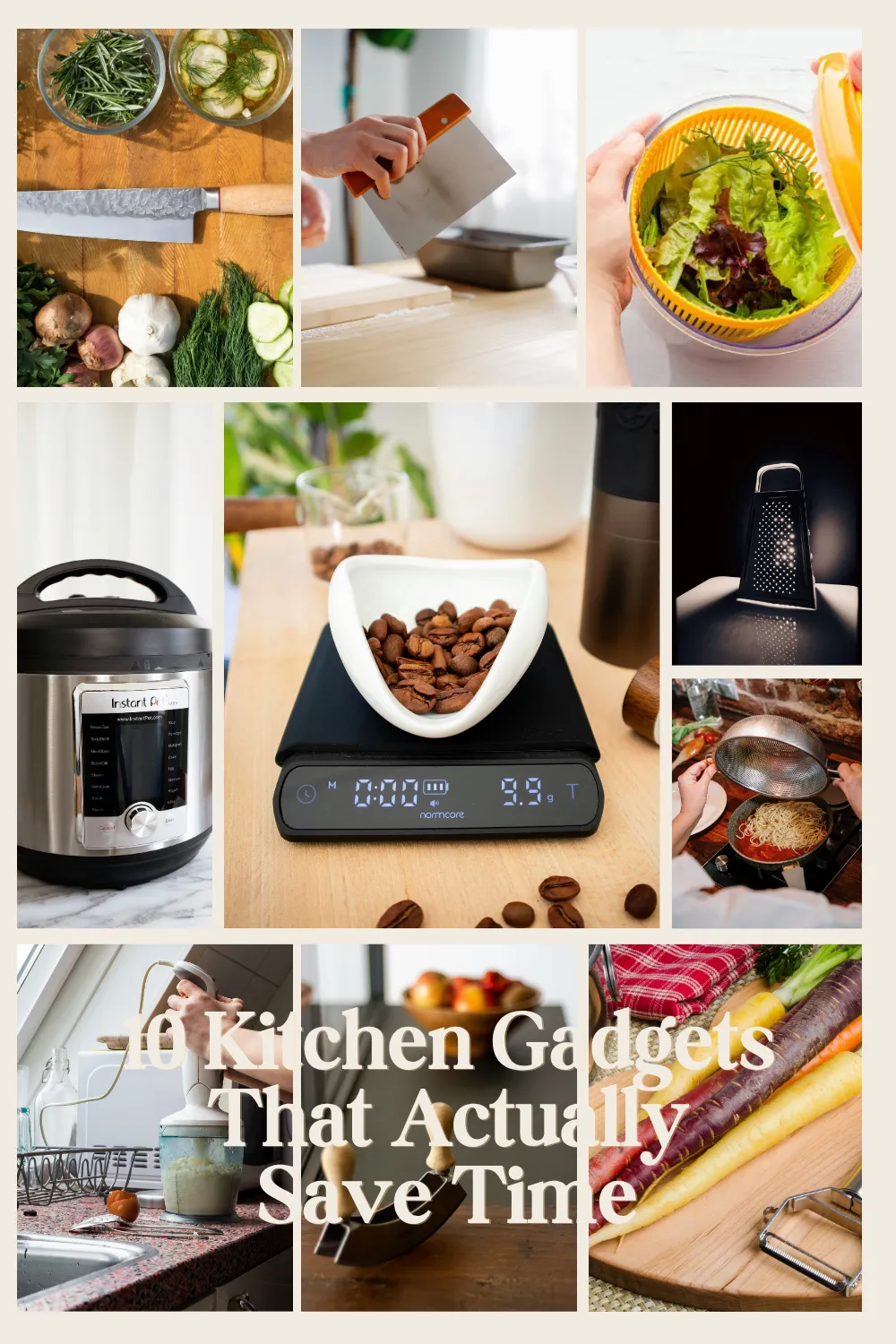
Every kitchen gadget claims to save time. Most of them save you thirty seconds on one task and then sit in a drawer, because the real cost isn’t the minute you spend using it. It’s the minute you spend digging it out, washing it, and finding somewhere to put it back. A gadget only earns its spot if the time it saves is bigger than the time it costs to own.
Here are ten that clear that bar, and a few notes on where each one stops being worth it.
1. A genuinely sharp chef’s knife
Not a knife block, not a set. One good chef’s knife, kept sharp. A dull knife doesn’t just slow you down, it makes every cut less precise, so you compensate by going slower and more carefully, which slows you down twice. A sharp knife glides through an onion in the time a dull one takes to get halfway.
Where it doesn’t help: it won’t fix bad knife technique, and a $200 knife that’s never sharpened will dull faster than a $30 one that’s maintained. The knife isn’t the upgrade. Keeping it sharp is.
2. A digital kitchen scale
Measuring cups create more than extra dishes. They’re a source of error. Packed versus loose flour can be a 20 to 30 percent difference in weight for the same “cup,” which is why the same recipe turns out differently every time you measure by volume. A scale removes the guessing, and for baking especially, that’s the difference between a recipe that works and one that sometimes works.
Where it doesn’t help: for cooking that isn’t precision-dependent, like most stovetop dinners, a scale adds a step without adding accuracy that matters.
3. A rocking-style garlic press
Mincing garlic by hand takes a cutting board, a knife, and a few minutes of fine chopping, plus the smell on your hands afterward. A press turns that into one squeeze. The output isn’t identical to hand-minced garlic, it’s wetter and more pulped, but for anything going into a hot pan, the difference disappears within a minute of cooking.
Where it doesn’t help: garnish-quality garlic, or anything where you want visible minced pieces rather than paste.
4. A box grater with a catch container
The time cost of grating cheese was never the grating. It was chasing shredded cheese across the counter and cleaning up afterward. A grater with an attached container turns a two-step mess into a one-step job: grate, then pour straight into the pan or bowl.
Where it doesn’t help: large quantities. Past a block or two of cheese, a food processor’s grating disc is faster.
5. A salad spinner
Wet lettuce doesn’t hold dressing, and patting greens dry with a towel is slow and only partially works. A spinner gets greens dry enough in one motion that dressing actually clings instead of pooling at the bottom of the bowl. It also doubles as a wash-and-store container, which removes a separate step.
Where it doesn’t help: cooking greens that are going into a hot pan anyway, where a little water left on the leaves doesn’t matter.
6. An immersion blender
Pureeing a pot of soup with a countertop blender means ladling hot liquid into a jar in batches, blending, and pouring it back, with a real risk of a hot-liquid accident at each transfer. An immersion blender goes directly into the pot. A five-step process with cleanup at every stage becomes one step with one thing to wash.
Where it doesn’t help: it doesn’t get purees as perfectly smooth as a high-powered countertop blender, so for something like a silky restaurant-style soup, the countertop blender still wins.
7. A bench scraper
A flat metal or plastic scraper does two jobs a knife is bad at: transferring chopped vegetables from cutting board to pan without them rolling off the blade, and clearing a floured counter after working with dough. It also works as a rough chopping tool for things like herbs, where precision doesn’t matter and speed does.
Where it doesn’t help: it’s not a knife substitute for anything that needs an actual clean cut.
8. A splatter screen
This one doesn’t save active cooking time. It saves cleanup time, which is easy to undercount. A mesh screen over a pan of frying or simmering food catches the grease that would otherwise end up on the stovetop, the backsplash, and the surrounding counter. Fifteen seconds to put it on saves what can be ten minutes of wiping down a kitchen afterward.
Where it doesn’t help: anything that isn’t actively splattering, like a covered simmer, where a lid already does the job.
9. A multi-cooker (Instant Pot-style)
The time saved here isn’t in the cooking. It’s in not having to be present for it. Dried beans that need hours of simmering and attention on a stovetop can go into a multi-cooker and finish unattended in under an hour. The same is true for tougher cuts of meat that would otherwise need a slow braise. Hands-on cooking time becomes hands-off waiting time, which matters more when you’re also managing a household during that hour.
Where it doesn’t help: quick weeknight meals that were already fast. A stir-fry doesn’t get faster in a multi-cooker.
10. A Y-shaped vegetable peeler
The Y-shape isn’t a gimmick. It lets your wrist stay in a natural position and lets you see the blade and the vegetable at the same angle, instead of twisting your wrist the way a straight peeler forces you to. On a task you repeat with almost every meal, a small reduction in friction per stroke adds up.
Where it doesn’t help: julienning or fine peeling work, where a straight peeler or a mandoline gives more control.
The actual test
None of these are exciting purchases. That’s the point: a gadget that saves real time usually isn’t the one that photographs well. It’s the one that removes a small piece of friction from something you do constantly. Before buying anything for the kitchen, the question isn’t “would this be useful,” it’s “will this still be in a drawer in six months, or will it be the thing I reach for without thinking.” Everything on this list passes that test. Most gadgets don’t.